Good Horse, Wrong Ground: Why Yesterday's Winner Can Fail Today
A horse that wins impressively on firm ground may struggle when the going turns soft—not because it's suddenly become a poor horse, but because the surface no longer suits its physical build or running style. This guide explains how ground preferences work, why small samples mislead punters, and how changed conditions create the most common form traps in British racing.
By Puntrr Editorial
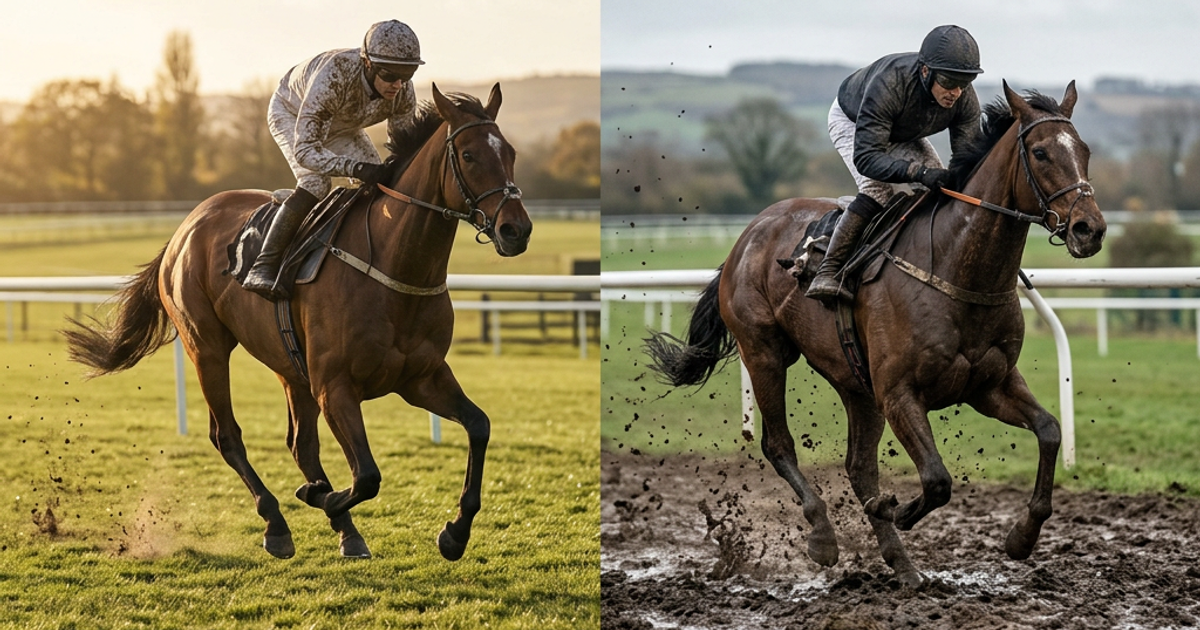
A horse that wins impressively on firm ground may struggle when the going turns soft—not because it's suddenly become a poor horse, but because the surface no longer suits its physical build or running style. Understanding ground preferences is one of the most reliable edges in racing, yet punters regularly fall into the trap of following form from one going condition into completely different underfoot conditions.
The term "going" refers to the state of the racing surface. The British Horseracing Authority uses standardised descriptors ranging from Heavy (waterlogged, deep mud) through Soft, Good to Soft, Good, Good to Firm, to Firm (hard, fast ground). Each step represents a significant change in how the surface affects horses during a race.
Why Ground Conditions Matter: Physics and Physiology
When ground is firm, it returns energy to the horse with each stride—favouring animals with sharp acceleration, light frames and quick leg speed. These horses often have neat, economical actions that skim across the top of the ground.
When ground turns soft or heavy, each stride sinks into the surface, requiring greater muscular effort and stamina to pull the hoof free. This benefits horses with powerful hindquarters, robust constitutions and grinding stamina. The energy cost per stride increases dramatically, turning races into tests of strength rather than speed.
Hypothetical example: Imagine Horse A winning a six-furlong sprint on firm ground by three lengths, clocking fast sectional times with a slick, economical action. Two weeks later, after heavy rain, Horse A runs in a similar race on heavy ground and finishes fifth, beaten ten lengths. The horse hasn't lost ability—the surface has shifted the demands of the race away from its strengths.
The Small Sample Problem: Why Ground Form Can Mislead
Most horses race infrequently on extreme ground conditions. A sprinter might have ten career runs on good to firm, two on good, and only one on soft ground. That single soft-ground run—whether a win or a defeat—provides very limited statistical evidence of true ability on testing surfaces.
Punters often overweight isolated performances. If that one soft-ground run resulted in a surprise victory, the market may assume the horse "acts on soft." But it could have been a weak race, a pace collapse, or simple variance. Conversely, a single poor run on soft might be dismissed or over-interpreted, when injury, a bad draw or other factors were responsible.
The British Horseracing Authority's handicappers consider ground when assessing performance figures, but even they must work with incomplete information when a horse encounters rare conditions. Smart punters recognise when a horse's ground-form sample is too small to be reliable, and adjust confidence accordingly.
Pedigree Clues and Breeding Patterns
When direct racecourse evidence is scarce, breeding offers useful secondary information. Certain sire lines consistently produce offspring that handle testing ground—often stallions who themselves stayed well or have Northern European pedigrees adapted to softer climates. Other bloodlines are speed-oriented, producing quick, light-framed horses who excel on fast surfaces but struggle when conditions get testing.
Checking a horse's sire, dam and siblings' ground preferences can help predict likely performance when a horse first encounters soft or heavy going. This is not infallible—individual variation is real—but it provides a probability edge when formbook evidence is thin.
Changed Conditions: The Form Trap in Action
One of the most common betting mistakes is backing a recent winner without checking whether today's ground matches the conditions of that victory. Racecards show recent form, but punters often fail to note the going descriptor beside each past run.
Hypothetical scenario: Horse B won its last two races on good to firm ground at two different tracks, recording strong speed figures. Today it races on soft ground for the first time this season. The market shortens Horse B based on recent wins, but the ground has fundamentally changed the test. Unless Horse B has proven soft-ground form elsewhere in its record—or strong breeding indicators—the recent wins may be irrelevant today.
Conversely, this creates value opportunities. A horse that ran poorly on firm ground in its last two starts might be overpriced today when returning to the soft ground on which it won earlier in the season. The market often overweights recent form and underweights ground context, allowing sharp punters to back horses whose true ability matches today's conditions even when recent form looks disappointing.
Practical Checklist: Assessing Ground Form Before Betting
- Check the going description for today's race—never assume it matches recent meetings at the same course.
- Review the going beside every line of the horse's recent form. Look for patterns: does the horse perform better on one end of the firm-to-soft spectrum?
- Count how many career runs the horse has on today's going. If fewer than three, treat ground form as uncertain.
- Examine close finishes and unlucky-in-running notes. A horse beaten narrowly on unsuitable ground might be well-handicapped when conditions suit.
- Look up the sire's progeny record on today's going if racecourse evidence is limited. Breeding isn't destiny, but it shifts probabilities.
- Be wary of horses stepping onto extreme ground (heavy or firm) for the first time. The market often underestimates risk here.
- Favour horses with multiple proven performances on today's going over those relying on one isolated run or unproven potential.
Uncertainty and Humility: What We Cannot Know
Even with diligent research, ground preference remains partly unknowable until tested. Going reports are subjective and vary across a course—the going stick reading on one part of the track may differ from the racing line. Horses mature, change training regimes, or develop new physical issues that alter their ground preferences over time.
Significant ground changes introduce genuine uncertainty into race analysis. This doesn't mean abandoning handicapping—it means adjusting stakes and confidence levels when evidence is thin or contradictory. Recognising when you don't know is as valuable as recognising when you do.
Before placing any bet, ask yourself whether you can afford to lose the stake from your entertainment or hobby budget—not money needed for bills, debts or essentials. Betting on uncertain ground form amplifies risk, making disciplined bankroll management even more important.
Practical Workflow: Integrating Ground Analysis
Start every racecard review by noting the official going. Compare it to the going for each horse's recent runs, ideally over the last six months. Highlight horses whose best form matches today's surface and flag those stepping onto unfamiliar ground.
Cross-reference ground form with course characteristics. Some tracks—like Chester or Catterick—are tight and turning, where ground changes affect pace and stamina demands differently than on wide, galloping venues like Doncaster or Newbury. A horse proven on soft ground at one track type may still be unproven on soft ground at a very different course layout.
Finally, integrate ground assessment with other form factors: class, distance, pace scenario, and recent trainer and jockey form. Ground suitability is necessary but not sufficient for success—every race requires a multi-factor analysis. However, backing a horse on unsuitable ground is one of the fastest routes to a losing betting record, no matter how strong the rest of the case appears.
Written by Puntrr Editorial
More stories